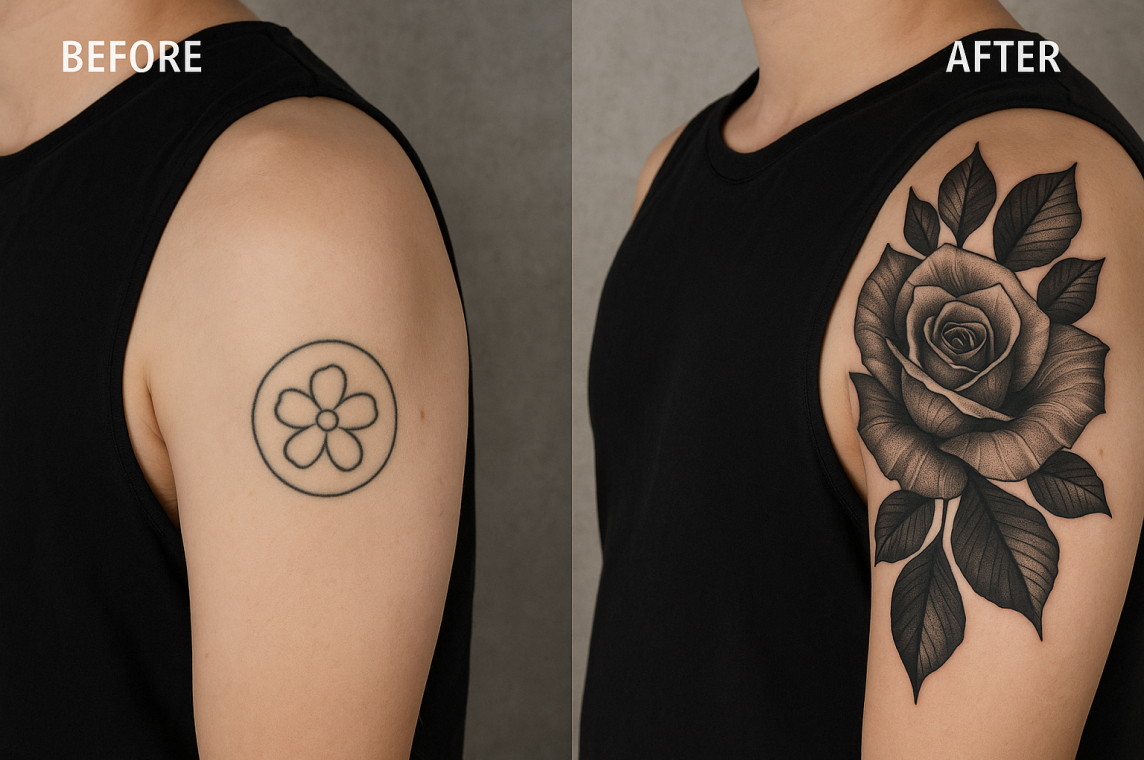
The day of the tattoo appointment - a day to look forward to. Even the more experienced tattooists among us often get at least a little excited, at least just before the appointment starts. Preliminary discussion or not - what will the end result look like? Will the tattoo artist match the image I have in mind? And what does the design that my tattoo artist has prepared for me actually look like?
The design - the basis for every tattoo, whether small lettering, a large-scale realism project or a Maori sleeve. A tattoo can be finely crafted and engraved to perfection - unplanned or inaccurate planning and placement will turn any motif, however small, into an eye-catcher in a negative sense. After all, the overall effect has to be right, not just the technical implementation. Accordingly, the tension rises before the first look at the planned motif, which is usually presented, discussed and/or worked out at the beginning of the session. Thanks to technology - with the help of drawing tablets and image editing software such as "Procreate" or "Photoshop", tattoo designs can now be created in a short space of time and can also be edited relatively easily, which makes the work much easier and quicker. Nevertheless, many colleagues, especially from older generations of tattoo artists, still prefer pen and paper to the Apple Pencil.
And yet - not every tattoo can be precisely visualized in advance. Although measurements can be taken and photos taken of the relevant body part, the shape of the body is and remains an important factor. It should be clear that a tattoo is not a 2-dimensional image, such as a drawing on paper or canvas. Muscles and bones have a decisive influence on the appearance of the tattoo, which makes it essential to adapt the motif. Just a few centimetres difference in alignment or a single unattractively placed line can become a disruptive factor. And as good as most motifs can be planned and aligned, a finished design is not necessarily useful in every case.
So-called freehand drawings, i.e. tattoo designs that are drawn directly onto the skin with sterile markers or brushes, are an elementary part of the tattoo artist's craft. Almost any motif can be started in the form of a sketch. Freehand drawing is particularly common in styles such as Maori (Polynesian), ornamental blackwork and similar abstract or ornamental styles. The motifs are usually so strongly adapted to the individual shape of the body that it is very difficult, if not impossible, to create an aesthetic placement using a conventionally printed stencil and apply it in an attractive way. This is where the marker comes into play - and with it a good deal of trust on the part of the customer. After all, it is reassuring to start a tattoo session with the knowledge of the exact motif. In the case of a freehand drawing, this is a little more complicated - preliminary sketches and a detailed preliminary discussion, also with sample images of the customer for desired motifs/elements, can make the elaboration easier. However, a direct sketch is associated with a much more intensive exchange during application - and is of course also somewhat more time-consuming.

Usually, the tattoo artist (after the usual hygienic preparation) works in the drawing from rough preliminary drawing to finer details. Different pen colors facilitate the visualization of light-dark contrasts and form contours. For ornamental projects, it is also usually essential to add auxiliary lines, such as line grids or tracing muscle contours. From the rough shape, outlines and area division to the addition of smaller details, an overall image is created piece by piece, which "fits" almost perfectly to the area to be tattooed. It is not for nothing that some tattoo artists work exclusively with such processes!


So what's wrong with simply starting every tattoo with a freehand sketch? One point here is the motif itself. With ornamental projects, there is often enough leeway in the design to allow creativity to flow in during the stencil placement, which makes the design a dynamic process. In comparison, however, photorealism, for example, lives from a very exact and, as the name suggests, "photorealistic" detailed realization of a motif. Anyone who has ever tried to trace a photo with pencils knows how time-consuming and complex such a drawing is. The tattoo result can be applied much more easily with a stencil - a freehand drawing is tantamount to a superfluous work step.
The accuracy of the preliminary drawing is also a factor - and the one that demands trust in the tattoo artist. A freehand drawing with markers is often by no means as precise and finely detailed as the finished tattoo - the drawing may even appear confusingly colorful and unclear to the customer's eye. First and foremost, it serves the tattoo artist as a basic construct for an image, which he holds in front of his inner eye. However, the addition of details to the skin sketch during the tattooing process is often all the more satisfying and amazing - expectations are bound to be exceeded!


At the end of the day, it is always advisable to take a tattoo artist's decision as to whether a stencil created in advance or a freehand drawing makes more sense for the project in question. All the more reason, however, to take a look at the portfolio or even talk to the tattoo artist in person beforehand. But trust can also pay off!


The day of the tattoo appointment - a day to look forward to. Even the more experienced tattooists among us often get at least a little excited, at least just before the appointment starts. Preliminary discussion or not - what will the end result look like? Will the tattoo artist match the image I have in mind? And what does the design that my tattoo artist has prepared for me actually look like?
The design - the basis for every tattoo, whether small lettering, a large-scale realism project or a Maori sleeve. A tattoo can be finely crafted and engraved to perfection - unplanned or inaccurate planning and placement will turn any motif, however small, into an eye-catcher in a negative sense. After all, the overall effect has to be right, not just the technical implementation. Accordingly, the tension rises before the first look at the planned motif, which is usually presented, discussed and/or worked out at the beginning of the session. Thanks to technology - with the help of drawing tablets and image editing software such as "Procreate" or "Photoshop", tattoo designs can now be created in a short space of time and can also be edited relatively easily, which makes the work much easier and quicker. Nevertheless, many colleagues, especially from older generations of tattoo artists, still prefer pen and paper to the Apple Pencil.
And yet - not every tattoo can be precisely visualized in advance. Although measurements can be taken and photos taken of the relevant body part, the shape of the body is and remains an important factor. It should be clear that a tattoo is not a 2-dimensional image, such as a drawing on paper or canvas. Muscles and bones have a decisive influence on the appearance of the tattoo, which makes it essential to adapt the motif. Just a few centimetres difference in alignment or a single unattractively placed line can become a disruptive factor. And as good as most motifs can be planned and aligned, a finished design is not necessarily useful in every case.
So-called freehand drawings, i.e. tattoo designs that are drawn directly onto the skin with sterile markers or brushes, are an elementary part of the tattoo artist's craft. Almost any motif can be started in the form of a sketch. Freehand drawing is particularly common in styles such as Maori (Polynesian), ornamental blackwork and similar abstract or ornamental styles. The motifs are usually so strongly adapted to the individual shape of the body that it is very difficult, if not impossible, to create an aesthetic placement using a conventionally printed stencil and apply it in an attractive way. This is where the marker comes into play - and with it a good deal of trust on the part of the customer. After all, it is reassuring to start a tattoo session with the knowledge of the exact motif. In the case of a freehand drawing, this is a little more complicated - preliminary sketches and a detailed preliminary discussion, also with sample images of the customer for desired motifs/elements, can make the elaboration easier. However, a direct sketch is associated with a much more intensive exchange during application - and is of course also somewhat more time-consuming.
Usually, the tattoo artist (after the usual hygienic preparation) works in the drawing from rough preliminary drawing to finer details. Different pen colors facilitate the visualization of light-dark contrasts and form contours. For ornamental projects, it is also usually essential to add auxiliary lines, such as line grids or tracing muscle contours. From the rough shape, outlines and area division to the addition of smaller details, an overall image is created piece by piece, which "fits" almost perfectly to the area to be tattooed. It is not for nothing that some tattoo artists work exclusively with such processes!
So what's wrong with simply starting every tattoo with a freehand sketch? One point here is the motif itself. With ornamental projects, there is often enough leeway in the design to allow creativity to flow in during the stencil placement, which makes the design a dynamic process. In comparison, however, photorealism, for example, lives from a very exact and, as the name suggests, "photorealistic" detailed realization of a motif. Anyone who has ever tried to trace a photo with pencils knows how time-consuming and complex such a drawing is. The tattoo result can be applied much more easily with a stencil - a freehand drawing is tantamount to a superfluous work step.
The accuracy of the preliminary drawing is also a factor - and the one that demands trust in the tattoo artist. A freehand drawing with markers is often by no means as precise and finely detailed as the finished tattoo - the drawing may even appear confusingly colorful and unclear to the customer's eye. First and foremost, it serves the tattoo artist as a basic construct for an image, which he holds in front of his inner eye. However, the addition of details to the skin sketch during the tattooing process is often all the more satisfying and amazing - expectations are bound to be exceeded!
At the end of the day, it is always advisable to take a tattoo artist's decision as to whether a stencil created in advance or a freehand drawing makes more sense for the project in question. All the more reason, however, to take a look at the portfolio or even talk to the tattoo artist in person beforehand. But trust can also pay off!
30.06.-02.07. Summer Tattoo Festival No.8
05.08.-06.08. Garda Tattoo Event
18.08.-20.08. Tunjo Tattoo Fest
15.09.-17.09. Millennium Tattoo Show No.6
15.09.-17.09. Cagliari Tattoo Convention No.13
22.09.-24-09. Bergamo Tattoo Expo
22.09.-24-09. Torino Tattoo Convention No.12
29.09.- 01.10. Urban Land Tattoo Expo Roma
29.09.-01.10. Mima Tattoo Convention No.5
13.10.-15.10. Genova Tattoo Convention No.16
14.10.-15.10. Roma Tattoo Expo No.23
20.10.-22-10. Ferrara Tattoo Convention No.5
27.10.-29.10. Passion Art Tattoo Convention Bolzano No.16
04.11.-05.11. Chiuduno Tattoo Weekend
10.11.-12.11. Ancona Tattoo Expo No.2
10.11.-12.11. Palermo Tattoo Convention No.9
11.11.-12.11. Trieste International Tattoo Expo No.14
11.11.-12.11. Catania Tattoo Convention No.5
01.12.-03.12. Florence Tattoo Convention No.13
08.12.-10.12. East Coast Tattoo Convention No.17
16.06.-18.06. Anime Tattoo Expo, Fire de Barcelona
30.06.-02.07.23 Asturias Tattoo Expo No.8
08.09.-10.09. Ibiza Tattoo Convention No.4
15.09.-17.09. Gaia Tattoo Expo No.3
06.10.-08.10. Barcelona Tattoo Expo No.26
27.10.-29.10. Alicante Tattoo Convention No.5
03.11.-05.11. Pamplona Tattoo Expo No.5
08.07.-09.07 . Bristol Tattoo Convention
22.07.-23.07 . Ink And Oil Tattoo Convention
29.07.-30.07. Great Western Tattoo Show
19.08.-20.08. Cornwall’s Tattoo Convention
19.08.-20.08. Tatcon Blackpool
26.08.-27.08. Big London Tattoo Show
16.09.-17.09. Buckley Ink Tattoo Convention
23.09.-24.09. Sheffield Tattoo Festival
30.09.-01.10. Tattoo Trojans Doncaster Tattoo Convention
07.10.-08.10. Locked up Tattoo Convention
14.10.-15.10. Halloween Tattoo Bash
11.11.-12.11. Wrexham Tattoo Show
02.09.-03.09. Tattoonika
14.10.-15.10. Wildstyle & Tattoo Messe Kapfenburg
21.10.-22.10. Wildstyle & Tattoo Messe Linz
28.10.-29.10. Wildstyle & Tattoo Messe Salzburg
01.09.-03.09. Lugano TI – Tattoo Convention No.24
16.06.-18.06. Epinal Tattoo Show
17.06.-18.06. Asian Festival Tattoo Show
01.07.-02.07. Caen Tattoo Show
08.07.-09.07. Rock Tattoo Spirit
15.07.-16.07. Sermaize Tattoo Convention
19.08.-20.08. Deauvile Tattoo Festival
01.09.-03.09. Montauban Tattoo Show
01.09.-03.09. Ink’n’Roll Chateauroux Tattoo Festival
02.09.-03.09. The 70’s Tattoo Show
09.09.-10.09. Jura Ink Park
09.09.-10.09. Dentelle Ink Alençon
09.09.-10.09. Champagne Tattoo Event
09.09.-10.09. Limoges Tattoo Show
15.09.-17.09. Univers Tattoo Convention
16.09.-17.09. Circus Tattoo Show
16.09.-17.09. Kustom Festival & Tattoo
16.09.-17.09. Perpignan Tattoo Convention
22.09.-24.09. Nantes Tattoo Convention
23.09.-24.09. Isere Tattoo Show
23.09.-24.09. Girl Ink Tattoo Show
30.09.-01.10. Perigueux Tattoo Expo
30.09.-01.10. La Maison d’Encre
07.10.-08.10. Convention Tatouage de Bourges
14.10.-15.10. Poitiers Tattoo Convention
13.10.-15.10. Chalons en Champagne Tattoo Show
20.10.-22.10. Evian Tattoo Show
21.10.-22.10. Biarritz Tattoo Fest
21.10.-22.10. Fabulous Tiki Weekend
21.10.-22.10. Bourg-en-Bresse Tattoo Convention
21.10.-22.10. The Team Miss P’ink Tattoo
28.10.-29.10. Cahors Tattoo & Geek
03.11.-05.11. Sugar Ink Tattoo Convention
11.11.-12.11. Love Tattoo Festival
18.11.-20.11. Potopistons Tattoo Convention
18.11.-19.11. Salon du Tatouage Clermont
25.11.-26.11. Troyes Tattoo Convention
01.12.-03.12. Merry Christmas Tattoo Show
02.12.-03.12. Nohell Tattoo Show
02.12.-03.12. Tarn Tattoo Convention
22.09.-24.09. Hans Christian Andersen Tattoo Convention No.6
27.10.-29.10. Nordic Ink Festival No.12
16.09.-17.09. Bulgaria Tattoo Expo VIII
25.08.-27-08. INKJUNX
02.09.-03.09. Craboutcha Tattoo Festival
02.09.-03.09. Tox Cit’Ink No.10
23.09.-24.09. Brügge Tattoo Convention No.2
07.10.-08.10. Skin Art Expo No.14
14.10.-15-10. Mons Tattoo Convention No.5
28.10.-29.10. Hasselt Tattoo Convention No.2
28.10.-29.10. Kempen Tattoo Convention No.3
10.11.-12.11. Brüssel Tattoo Convention No.13
16.09.-17.09. Haná Tattoo Expo No.5
18.11. Pardubice Tattoo Event No.8
28.07.-30.07. Maiden City Tattoo Convention No.11
29.09.-01.10. Dublin Tattoo Convention No.22
21.10.-22-10. Wild Atlantic Tattoo Show
25.08.-27.08. Baltic Tattoo Convention No.5 ^
21.10.-23.10. Vianden Tattoo Convention No.23
15.07.-16.07. Ink Panthers Tattoo Convention No.2
15.09.-17.09. Amsterdam Tattoo Convention No.17
23.09.-24.09. Ink and Cutz Tattoo Convention No.6
01.07.-02.07. Warsaw Tattoo Convention No.10
02.09.-03.09. Katowice Tattoo Konwent
16.09.-17.09. Opole Tattoo Expo No.5
14.10.-15.10. Hagen Tattoo Convention
25.11.-26.11. Lodz Tattoo Konwent
05.10.-08.10. Lisbon Tattoo Rock Fest No.16
01.09.-03.09. Constanta Tattoo Convention
20.10.-22-10. Bucharest Tattoo Convention No.11
06.08.-13.08. Ink Needle Tattoo Convention
25.08.-26.08. Minicon
01.09.-03.09. Stockholm Ink Bash Tattoo Convention No.26